
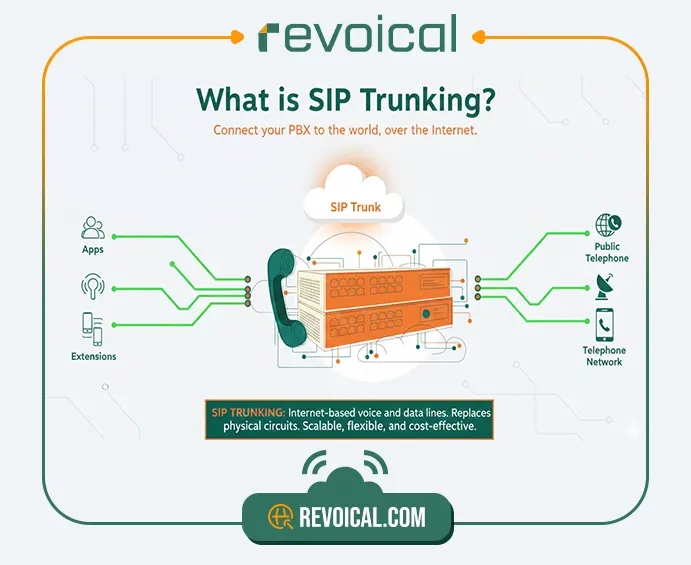
If you’ve heard the term but aren’t sure what it means, think of SIP trunking as the Internet-based way to give your business phone system outside lines. In this guide, we explain what is SIP trunking in clear terms, show how a call travels from your IP PBX to the public phone network, outline the key benefits and real costs, and finish with a quick checklist to see if it’s the right fit for your team.
Definition of SIP Trunk
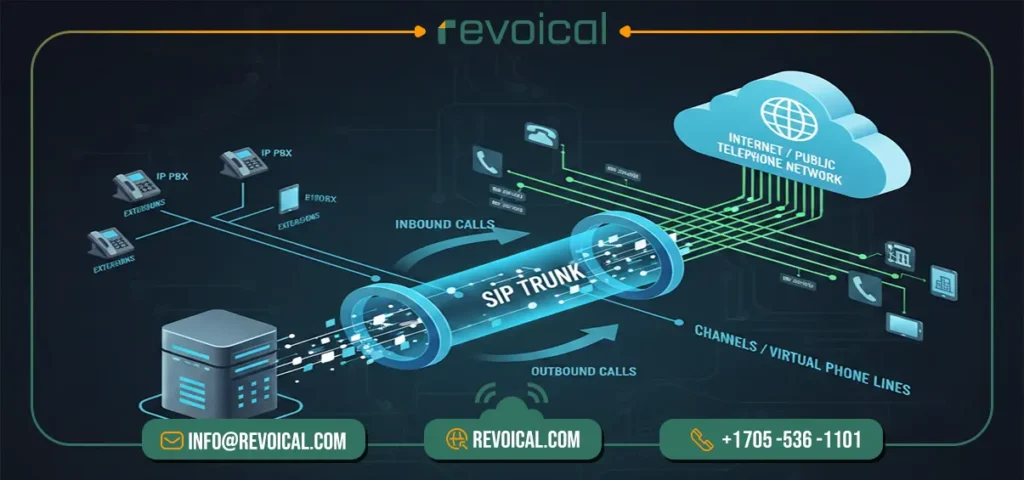
SIP (Session Initiation Protocol) trunking is the simplest way to connect a business phone system to the outside world over the Internet. In practice, SIP (Session Initiation Protocol) links your IP PBX to the public telephone network without physical PRI/T1/E1 lines.
In plain terms, a “trunk” is a bundle of virtual phone lines (“channels”) that replaces fixed PRI circuits. Instead of buying fixed circuits, you purchase channels (concurrent call paths) and DIDs (direct phone numbers) from a SIP provider, then place inbound and outbound calls across your broadband connection. SIP sets up and ends the calls, while the audio travels as data over IP.
If you’re asking “what is SIP trunking” or looking for a clear sip trunking definition, the meaning of sip trunking is: internet-based call capacity and numbering for your PBX, delivered as a scalable service. For business sip trunking, this brings quick number provisioning, elastic capacity during peak times, and simpler failover policies—while keeping control of routing and extensions inside your own PBX.
Read More: What Is VoIP and How Does It Work?
How SIP trunking works?
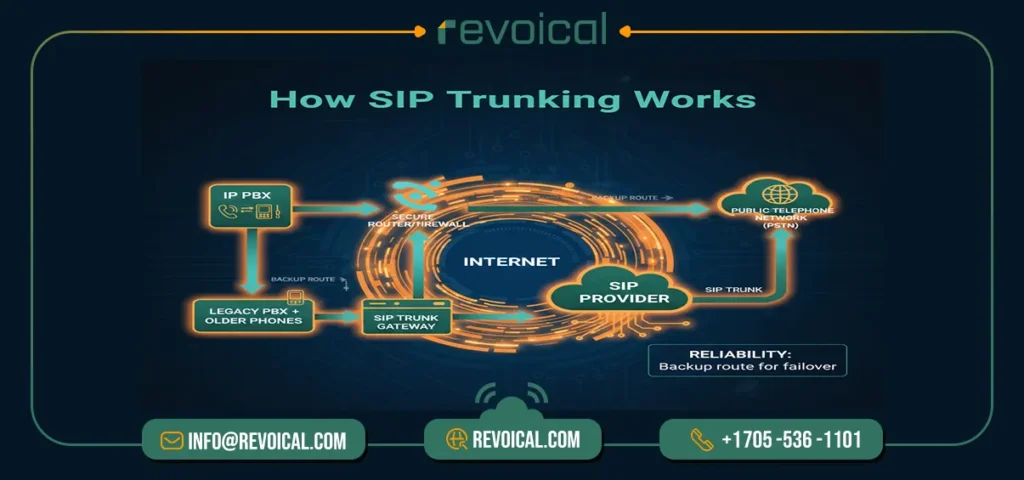
Think of SIP trunking as the path your calls take over the Internet. Your business phone system (IP PBX) signs in to a SIP provider (this is the session initiation protocol sip trunking part), and from there every call follows a simple route:
IP PBX → secure router/firewall → Internet → SIP provider → regular phone network (PSTN)
SIP sets the call up and ends it; the voice itself travels as audio data, using common phone formats like G.711 or Opus. If you still have older phones or a legacy PBX, a small sip trunk gateway can connect them to this Internet path. For reliability, you can add a backup route (another SIP trunk or a secondary Internet link) so calls keep working even if your main ip pbx sip trunking connection has an issue.
See More: Revoical Hosted PBX
What’s the Difference? SIP vs VoIP, SIP Trunking vs PRI/Hosted PBX
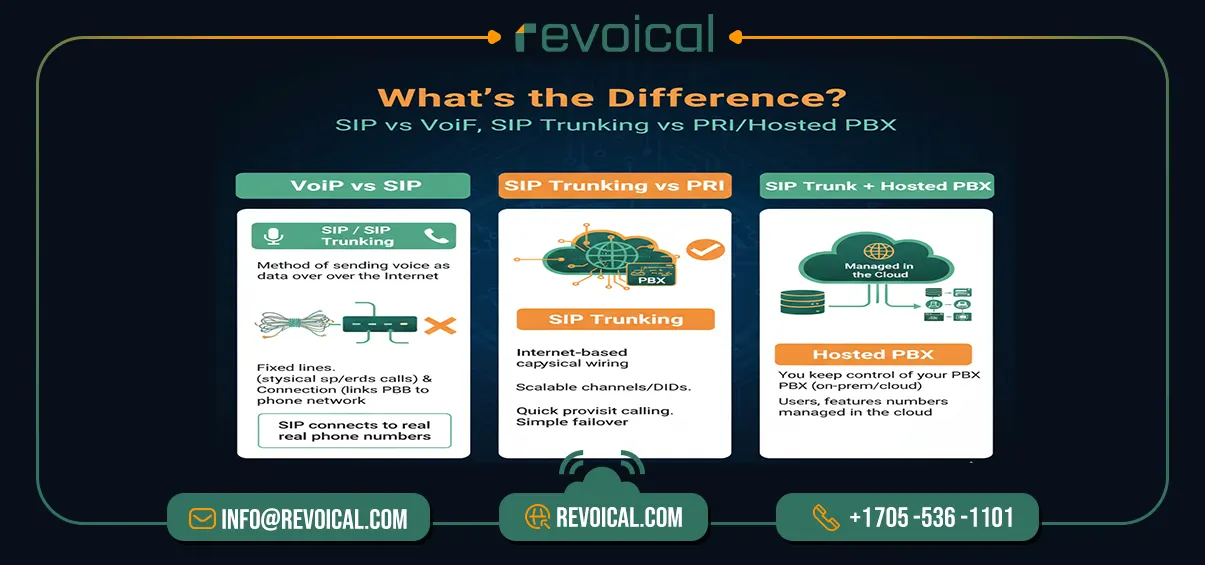
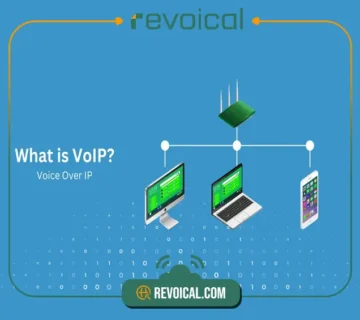
If you’re wondering what is difference between SIP and VoIP, here’s the simple version. VoIP is the idea of sending voice as data over the Internet. SIP (Session Initiation Protocol) is the common language that sets up and ends those calls—and a SIP trunk is the connection that links your business phone system to the public phone network. In short: VoIP is the method; SIP (and SIP trunking) is how you connect it to real phone numbers.
When people ask about sip trunking vs PRI, they’re comparing Internet-based calling capacity with old fixed lines (T1/E1). PRI gives you a fixed number of channels and needs physical wiring. SIP trunking delivers channels over your Internet, so you can add capacity quickly, get numbers (DIDs) faster, and set simple failover rules for outages. Most businesses prefer SIP because it scales up or down without a site visit.
Finally, sip trunk vs hosted pbx is about who runs the phone system. With a SIP trunk, you keep your own PBX (on-prem or in the cloud) and just buy the external calling connection. With a Hosted PBX, the provider hosts the PBX for you—users, features, and numbers are all managed in the cloud. If you want control of your existing PBX, choose a SIP trunk; if you want less to manage, Hosted PBX keeps it simple.
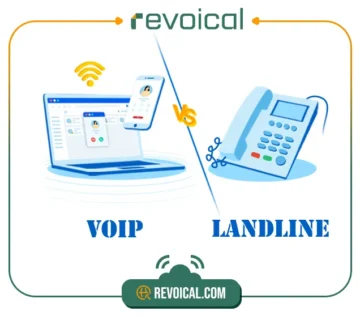
Related Post: VoIP vs Landline vs Mobile
Advantages of SIP trunking (why teams switch)
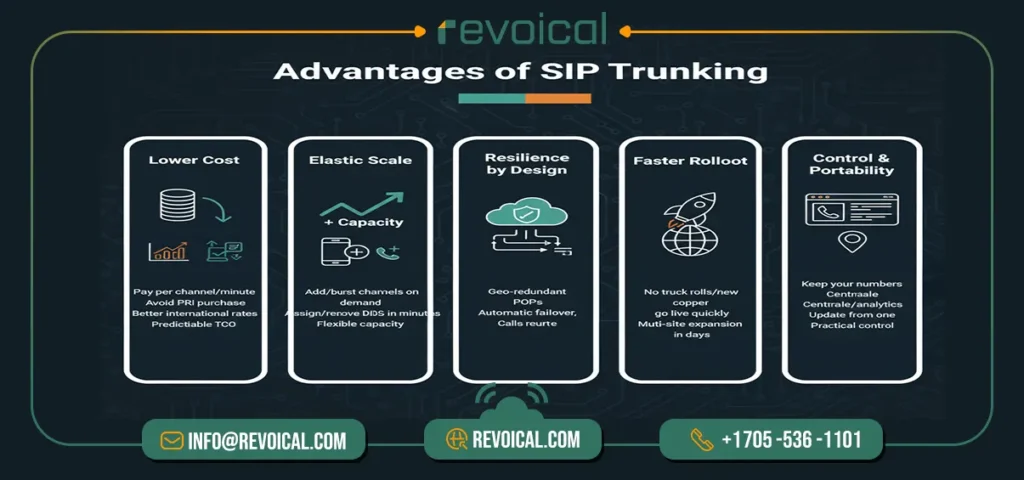
- Lower cost: One of the key advantages of SIP trunking is pricing: you pay per channel or minute, avoid buying PRIs, and often get better international rates—so your monthly TCO is easier to predict.
- Elastic scale: Need more capacity for a campaign or peak season? Add or “burst” channels on demand and assign/remove DIDs in minutes. This flexibility is a major advantage of SIP trunking over PRI.
- Resilience by design: Quality providers offer geo-redundant points of presence and automatic failover to alternate trunks or sites. If one path drops, calls reroute—keeping the business reachable.
- Faster rollout: No truck rolls or new copper. Remote offices go live over the Internet you already have, so multi-site expansion happens days faster than circuit installs.
- Control & portability: Keep your numbers, centralize routing and analytics across locations, and update caller ID, hours, or rules from one dashboard—practical control you don’t get with fixed PRI circuits.
Read More: Advantages and Disadvantages of VoIP services
SIP trunking costs (what really drives price)
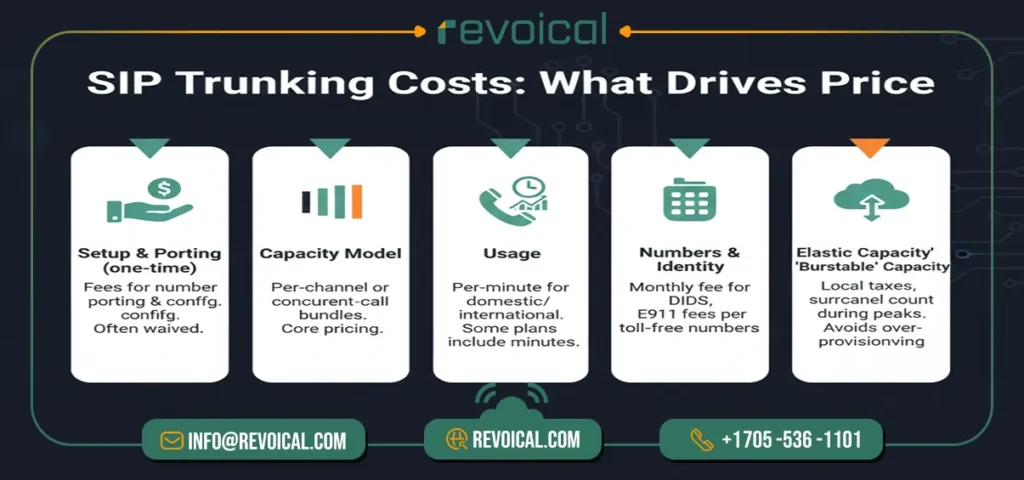
When teams ask about sip trunking cost, the total usually comes from a small set of predictable items. If you understand these line items, you can compare sip trunk pricing across providers quickly and avoid surprises on the first invoice.
What you typically pay for
- Setup and porting (one-time): Most providers charge a modest fee to port your existing numbers and complete initial configuration, although some plans waive these charges during promotions.
- Capacity model: Pricing is commonly based on per-channel capacity (concurrent call paths) or on concurrent-call bundles; this choice is the centerpiece of any sip trunk pricing comparison.
- Usage: You will pay per-minute for domestic and international calls, unless your plan includes a domestic minute allowance.
- Numbers and identity: Direct numbers (DIDs), optional CNAM (caller name), and toll-free numbers are billed monthly and add to the overall sip trunking cost.
- Regulatory and safety: Local taxes, surcharges, and E911 fees apply per number or per location, depending on your jurisdiction.
- Elastic or “burstable” capacity: Some providers offer elastic sip trunking, which lets you exceed your channel count during short peaks so you do not have to permanently over-provision.
Tiny budgeting example (illustrative only)
A small office might plan for 10 channels, 20 DIDs, 1,000 domestic minutes, E911 on each DID, and a small amount of international traffic. With this snapshot, you can test “what-if” scenarios—for example, increasing to 15 channels during peak season—and see how elastic bursting would change the monthly total.
Practical ways to keep costs in check
- Size channels to your busy hour: Estimate your maximum concurrent calls and rely on bursting for short spikes instead of buying permanent capacity you rarely use.
- Port only the numbers you need: Retire unused DIDs or forward them temporarily to reduce recurring charges.
- Separate high-cost destinations: Track international calls as a dedicated cost center so you can monitor rates and set alerts.
- Look beyond the sticker price: Extremely cheap sip trunking can omit support, redundancy, or E911; these gaps often increase total cost of ownership later.
Want a clear estimate for your mix of channels, DIDs, and minutes? See the Telephony Protocols section of Revoical HostedPBX features.
Is SIP trunking right for you?
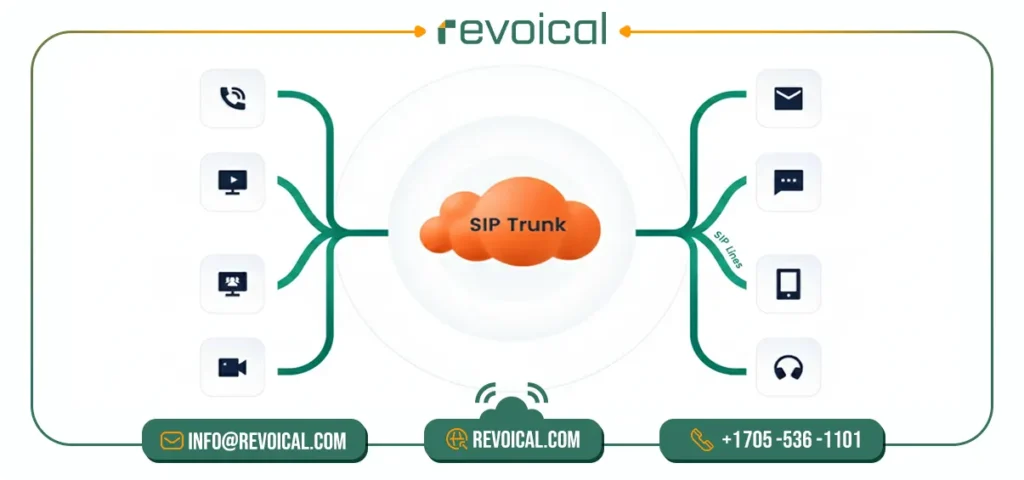
If your company already runs a PBX and wants to retire old PRI lines, SIP trunking is usually a good fit. It lets you keep your existing call flows and extensions while moving the outside connection to the Internet, so multi-site calling becomes simpler and adding capacity for seasonal peaks is quick—you can increase concurrent call “channels” for a campaign and scale back afterward.
Teams that run a contact center also benefit because inbound and outbound volume can grow without waiting for new circuits. In short, pbx and sip trunking work well together when you want to modernize the edge of your system, not replace it.
If you don’t have PBX expertise, or you’re a very small team that prefers an all-cloud setup, a sip cloud pbx (Hosted PBX) may be easier. In that model, the provider hosts the phone system, and you manage users and features in a web dashboard without maintaining servers.
Before you decide, run a quick readiness check in plain language: make sure your Internet is stable and that your router can give calls priority (QoS); keep the modem/router on a small UPS so short power cuts don’t drop calls; confirm your firewall rules are set so the system can register cleanly; ensure your 911 service address is up to date; and look at the number-porting timeline so cutover day is smooth. If those boxes look reasonable, SIP trunking will feel straightforward and give you room to grow.
See: Revoical Soloutions
Conclusion
SIP trunking gives your IP PBX internet-based outside lines—scalable channels, quick DID provisioning, and simple failover—so you can reduce costs and grow without new wiring. If you’re weighing the move or have questions about network readiness, pricing, or E911 setup, reach out to the Revoical team for a quick consultation—we’re happy to review your requirements and help you choose the right path.
FAQ
SIP trunking is an Internet-based way to give your PBX outside phone lines. Instead of physical PRI circuits, you buy channels (concurrent call paths) and DIDs (direct numbers) from a provider and place inbound/outbound calls over broadband—this is the plain what is SIP trunking definition most teams need.
VoIP is voice carried as data; SIP is the protocol that sets up those calls, and a SIP trunk is the connection to the public phone network. Compared with PRI (fixed T1/E1 lines), SIP trunking uses Internet-based channels, so capacity scales quickly, numbers provision faster, and disaster recovery is simpler (sip trunking vs PRI in one line).
Your sip trunking cost usually includes setup/porting, per-channel or concurrent-call capacity, per-minute domestic/international usage, numbers (DIDs/CNAM/toll-free), E911, and taxes. Knowing these items lets you do a fast sip trunk pricing comparison and pick the right plan without surprises.
Plan roughly ~100 kbps up & down per active call, keep latency/jitter low, and enable basic QoS so large downloads don’t affect audio. With a stable link and a small UPS for your modem/router, business SIP trunking delivers call quality comparable to traditional lines.
If you already run a PBX and want control, pbx and sip trunking is a good fit: keep your system, modernize the outside connection, and scale channels as needed. If you prefer not to manage a PBX, a sip cloud PBX (Hosted PBX) moves features and users to the provider’s cloud so you manage everything in a web dashboard.

No comment