

Have you ever called a company and got stuck in a “press 1, press 2” menu? What if you could just say what you need instead?
Conversational IVR is a modern, AI-powered version of traditional IVR systems that allows callers to speak naturally instead of navigating complex menus. Instead of pressing numbers, users can simply say things like “billing issue” or “track my order,” and the system understands their request and responds accordingly.
By using technologies like speech recognition and natural language understanding, conversational IVR systems identify caller intent, provide answers, or route calls to the right agent—faster and with fewer steps.
The result is a smoother, more human-like experience that reduces wait times, minimizes transfers, and helps both customers and support teams get to the right outcome more efficiently.
What is Conversational IVR?
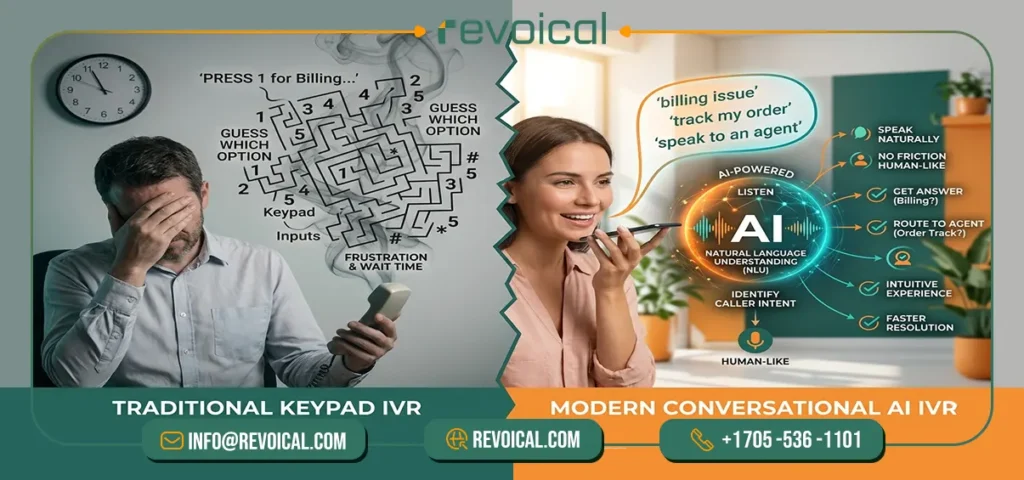
Conversational IVR is a modern, AI-powered phone system that allows callers to speak naturally instead of navigating traditional “press 1, press 2” menus. In simple terms, when someone calls your business, they can just say what they need—like “billing issue” or “track my order”—and the system understands and responds accordingly.
This is the core conversational IVR meaning: replacing rigid, number-based menus with natural human conversation. Instead of forcing users to follow predefined options, the system listens, identifies the caller’s intent, and either provides an answer or routes the call to the right destination.
To understand what is conversational IVR more clearly, it helps to compare it with traditional IVR systems. In older systems, users must choose from a list of options using keypad inputs. In contrast, conversational IVR—powered by conversational AI—uses speech recognition and natural language understanding to interpret what the caller says in real time.
The result is a more intuitive and human-like experience. Callers do not need to guess which option to select—they simply express their request in their own words, and the system takes care of the rest. This approach reduces friction, speeds up resolution, and makes interactions feel more natural for both customers and support teams.
How Conversational IVR Works (Behind the Scenes)
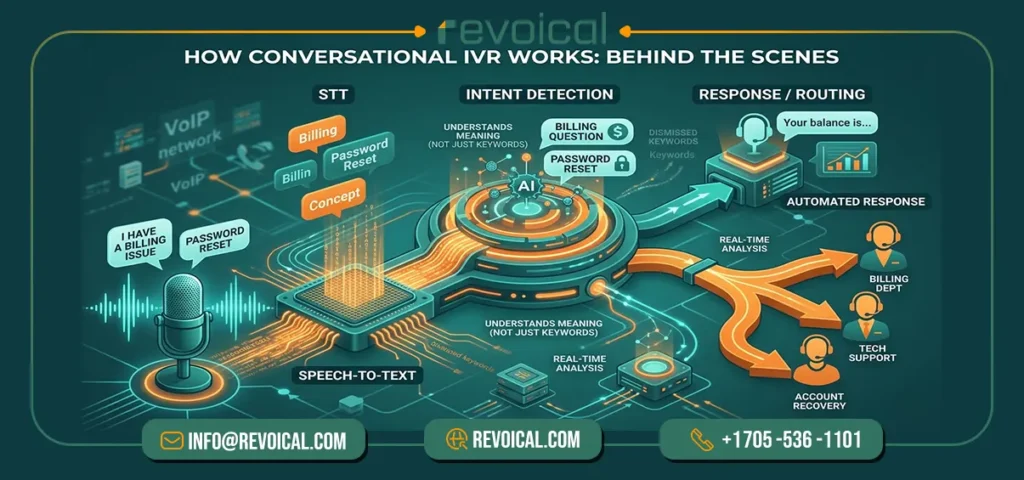
At its core, conversational IVR follows a simple flow that makes voice interactions feel natural and fast. Instead of navigating menus, the system processes what the caller says and responds in real time using IVR conversational AI.
The process can be understood in three clear steps:
Speech-to-Text → Intent Detection → Response / Routing
When a caller speaks, the system first converts the voice into text using speech recognition. It then analyzes that text to understand the caller’s intent—what they actually want to do, such as checking a bill or resetting a password. Finally, based on that intent, the system either provides an automated response or routes the call to the right destination.
This is essentially how conversational AI works in a VoIP environment:
the system listens, understands meaning (not just keywords), and takes the appropriate action.
Because everything happens in real time, the interaction feels smooth and conversational rather than step-by-step like traditional IVR. The caller does not need to follow predefined options—the system adapts to the request and guides the conversation naturally.
Related Featurs Of Revoical Hosted Pbx: Advanced Voice & AI Features
Conversational IVR vs Traditional IVR
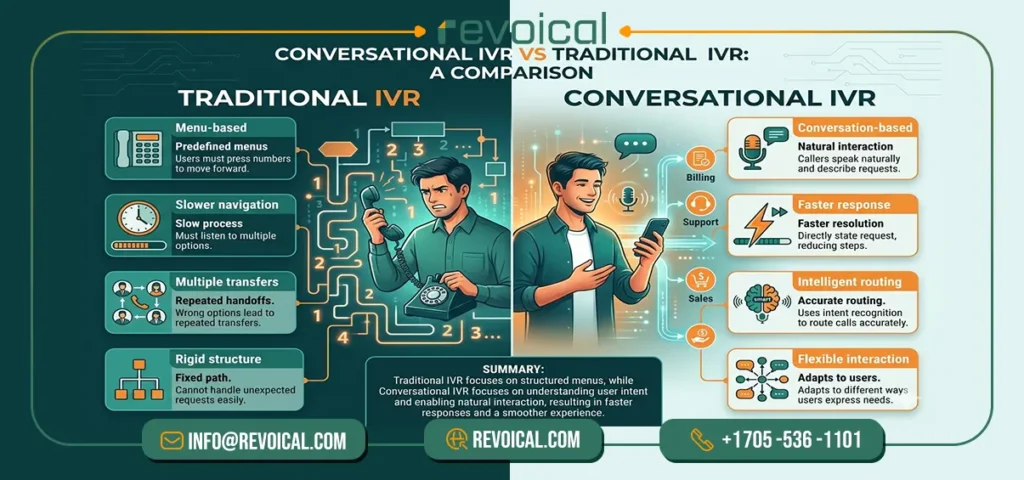
The difference between conversational IVR and traditional IVR is best understood through how users interact with the system and how quickly they reach the right outcome. While both are designed to handle inbound calls, their approach is fundamentally different.
- Menu-based vs Conversation-based
Traditional IVR relies on predefined menus where users must press numbers to move forward. In contrast, conversational IVR allows callers to speak naturally and describe their request, making the interaction more flexible and intuitive.
- Slower navigation vs Faster response
In traditional IVR, callers often need to listen to multiple options before selecting the right one, which can slow down the process. With IVR conversational AI, users can directly state their request, reducing the number of steps and reaching a resolution faster.
- Multiple transfers vs Intelligent routing
Traditional systems may route calls incorrectly if the user selects the wrong option, leading to repeated transfers. Conversational IVR uses intent recognition to route calls more accurately from the start, minimizing unnecessary handoffs.
- Rigid structure vs Flexible interaction
Traditional IVR follows a fixed path and cannot handle unexpected requests easily. On the other hand, conversational IVR adapts to different ways users express their needs, which is a key part of how conversational AI works in real-world scenarios.
In summary, traditional IVR is built around structured menus, while conversational IVR is designed around understanding user intent and enabling natural interaction. This shift results in faster responses, fewer transfers, and a smoother overall experience for callers.
Related post: What Is Intelligent Call Routing?
A Simple Conversational IVR Flow (Real Example)
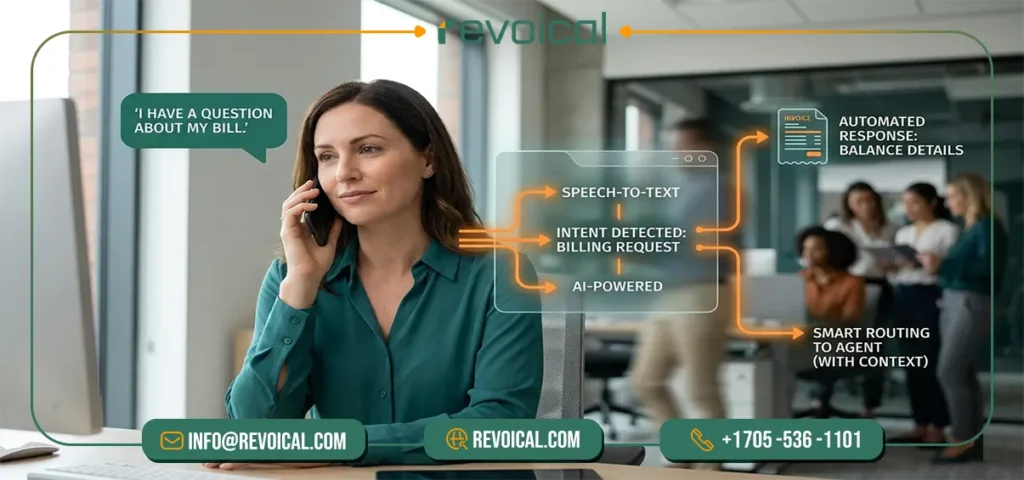
To better understand a conversational IVR example, let’s walk through a simple real-world scenario. This shows how the system handles a request from the moment the caller speaks to the final response.
Example scenario: Billing question
- Caller speaks naturally
The user calls and says: “I have a question about my bill. Unlike traditional systems, there is no need to press buttons or follow menus. - Intent is detected automatically
The system converts the speech into text and identifies the intent as a billing request using conversational AI. Even if the user phrases it differently, the meaning is still understood. - System decides the next step
Based on the detected intent, the conversational IVR determines the best action:
o Provide an automated answer (e.g., latest invoice details)
o Ask a follow-up question if needed
o Or route the call to the billing team - Response or routing happens instantly
The system responds using natural voice or transfers the call to the correct agent with context already attached, reducing repetition and delays.
A typical conversational IVR flow looks like this:
User request → Intent recognition → Response or smart routing
This example shows how conversational IVR removes unnecessary steps and replaces them with a direct, intent-based interaction. Instead of navigating menus, users simply say what they need—and the system handles the rest in a fast and natural way.
Related Post: Top Features in a Modern Cloud-Hosted PBX
Key Benefits of Conversational IVR for VoIP Systems

Using conversational IVR in a VoIP environment directly improves how calls are handled, both for users and support teams. Instead of focusing on long feature lists, the real value comes from a few practical benefits that impact daily operations:
- Reduced wait times
By understanding user intent immediately, conversational IVR removes unnecessary menu steps and connects callers to the right answer faster. This leads to shorter queues and quicker resolutions compared to traditional IVR systems. - Fewer call transfers
With IVR conversational AI, the system identifies the caller’s request more accurately from the beginning. This reduces misrouting and eliminates the need for multiple transfers between departments, improving the overall call flow. - Increased self-service
Many common requests—such as checking order status, business hours, or basic account information—can be handled automatically. This allows conversational IVR to resolve a large portion of calls without involving a live agent. - Better context for agents
When a call is transferred, the system can pass along the conversation details or intent. This means agents start with context instead of asking the caller to repeat information, which improves efficiency and customer experience.
In practice, these conversational IVR benefits make voice interactions faster, more accurate, and less frustrating. For businesses using VoIP or cloud PBX systems, this translates into lower operational load, better use of agents, and a smoother experience for every caller.
Common Use Cases (Where It Actually Helps)
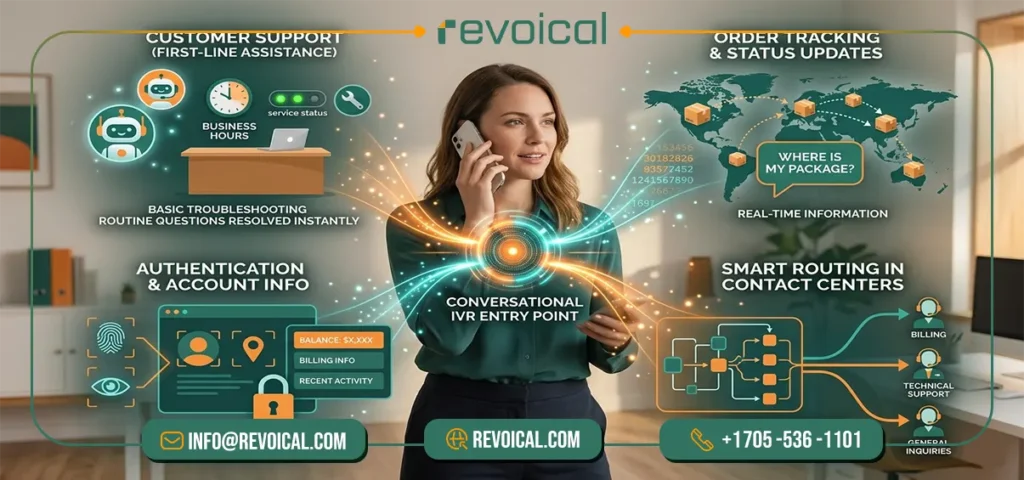
In real-world scenarios, conversational IVR is most effective when handling repetitive, high-volume requests that do not always require a human agent. By using IVR conversational AI, businesses can automate common interactions while still providing a smooth and natural experience.
Some of the most practical conversational IVR use cases include:
- Customer support (first-line assistance)
Conversational IVR can handle common support requests such as business hours, service status, or basic troubleshooting. Many routine questions are resolved instantly without involving an agent, improving response time and reducing workload. - Order tracking and status updates
Callers can simply ask about their order—such as “Where is my package?”—and the system retrieves and delivers real-time information. This is one of the most common self-service scenarios in conversational IVR systems. - Authentication and account information
The system can guide users through identity verification and provide account-related details like balance, recent activity, or billing information in a secure and conversational way. - Smart routing in contact centers
Instead of sending calls through multiple layers, conversational IVR identifies intent and routes the call directly to the right team or agent. This improves accuracy and reduces unnecessary transfers.
So these use cases show how conversational IVR goes beyond simple call handling. It acts as a smart entry point for customer interactions—automating repetitive tasks while ensuring that more complex requests are handled by the right resource from the start.
Conversational IVR in Cloud PBX
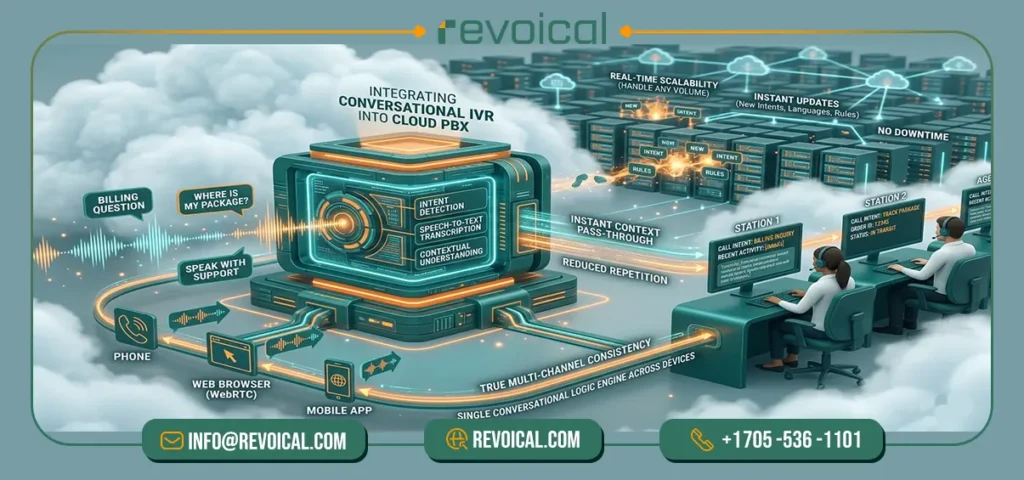
When conversational IVR is integrated into a cloud PBX, it becomes more than just a voice interface—it turns into a central layer for managing and optimizing all inbound interactions. Instead of operating as a simple call menu, it works alongside cloud infrastructure to deliver faster routing, better context, and a consistent experience across channels.
In a cloud PBX environment, conversational IVR can instantly understand the caller’s intent and route the call to the right destination while passing along a short transcript or context. This means agents no longer start from zero—they already know the reason for the call, which improves resolution time and reduces repetition.
At the same time, cloud-based systems allow this experience to extend beyond traditional voice calls. With technologies like WebRTC and browser-based calling, users can interact with the same conversational flow across phone, web, or app—creating a true multi-channel experience without changing the logic behind it.
Another key advantage is scalability. Because everything runs in the cloud, conversational IVR can handle increasing call volumes without additional infrastructure, while updates such as adding new intents, languages, or routing rules can be applied in real time without downtime.
In practice, this combination of conversational IVR and cloud PBX enables a flexible and scalable communication system where calls are handled intelligently, experiences remain consistent across channels, and businesses can continuously improve their call flows without disruption.
See: Revoical Hosted Pbx
Is Conversational IVR Worth It?
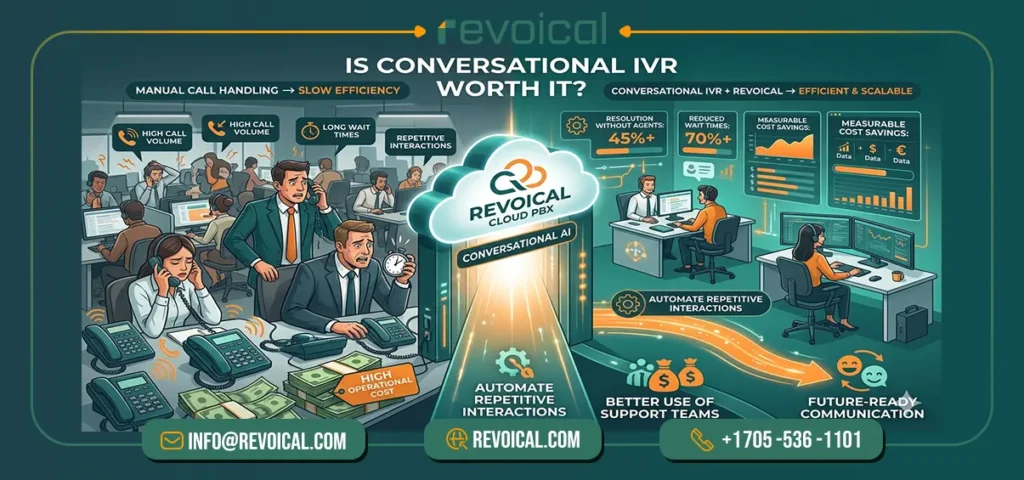
For most businesses, conversational IVR becomes truly valuable when call volume grows and handling requests manually starts to impact speed and efficiency. By using IVR conversational AI, companies can automate repetitive interactions, reduce wait times, and resolve a significant portion of calls without agent involvement—improving both response time and overall experience.
In many cases, automation can handle a meaningful share of routine requests, leading to measurable cost savings and better use of support teams.
At the same time, conversational IVR helps build a more scalable communication system. As your operations expand, it allows you to maintain service quality without increasing complexity or staffing at the same rate.
When combined with a modern cloud PBX solution like Revoical , it becomes easier to manage call flows, introduce automation gradually, and deliver a consistent voice experience across your organization—making it a practical step toward more efficient and future-ready communication.
FAQ
Yes, most conversational IVR systems are trained to recognize different accents and variations in speech. While performance improves over time with more data, modern systems can already handle a wide range of speaking styles with good accuracy.
Yes. One of the key advantages is 24/7 availability. Conversational IVR can answer calls, provide information, or collect requests even when your team is offline, ensuring no opportunity is missed.
Conversational IVR systems can be configured with security measures such as identity verification and data protection protocols. When properly implemented, they can safely handle tasks like account inquiries or basic authentication.
Initial setup requires defining common user intents and call flows, but modern platforms make deployment relatively straightforward. Over time, the system improves as it learns from real interactions and usage patterns.
Yes. Conversational IVR can connect with CRM systems, databases, and other tools to retrieve real-time information and provide more personalized responses. This integration is what enables more accurate routing and better customer experience.


No comment