

An AI Assistant in VoIP (voice ai assistant) is changing the way businesses handle phone conversations. Instead of sending every caller directly to a queue or a fixed phone menu, an AI-powered assistant can greet callers, understand their needs, answer simple questions, and guide them to the right next step.
For businesses, this means faster responses, fewer missed opportunities, and a more intelligent call experience. In this article, we’ll explain how a VoIP AI assistant works, how it supports real customer conversations, and why it is becoming an important part of modern business phone systems.
What Is an AI Assistant in VoIP?
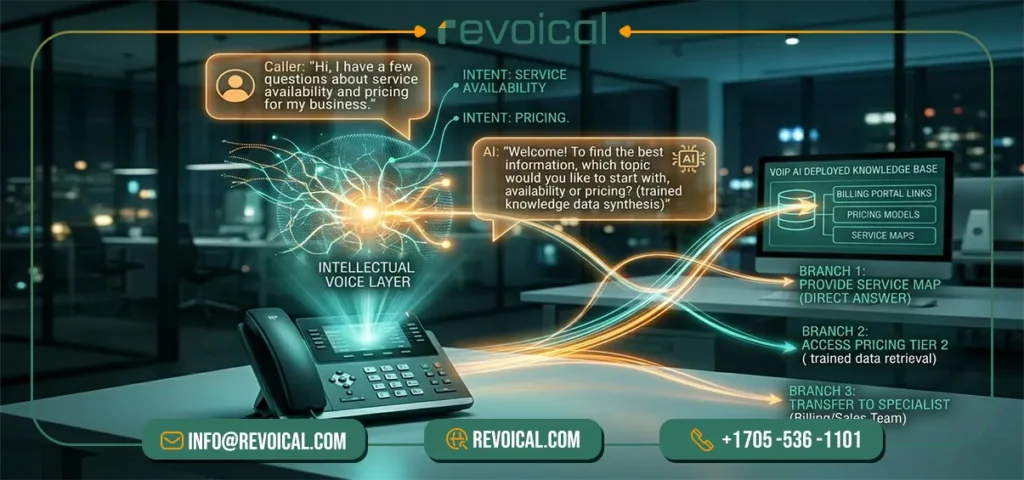
An AI assistant on call is an intelligent voice component that works inside a business phone system to manage incoming calls more naturally. Instead of only sending callers through a fixed menu or waiting line, it can listen to the caller, understand the purpose of the call, and respond in a conversational way.
A VoIP AI assistant acts as the first point of contact between a business and its callers. It can answer common questions, collect basic information, and guide the caller to the right next step. For example, if a customer calls about pricing, support, billing, or service availability, the assistant can recognize the request and either provide a direct answer or transfer the call to the right team.
Unlike a traditional phone menu, an AI phone assistant is designed to support real conversation. Callers do not always need to press numbers or follow a fixed path. They can explain what they need in their own words, and the assistant can respond based on the information it has been trained on.
In simple terms, an AI assistant brings a smarter layer to VoIP calling. It helps businesses handle routine calls faster, gives customers a clearer starting point, and makes the phone system more useful than a basic call-routing tool.
See More: Revoical Hosted PBX
How Does a VoIP AI Assistant Work?
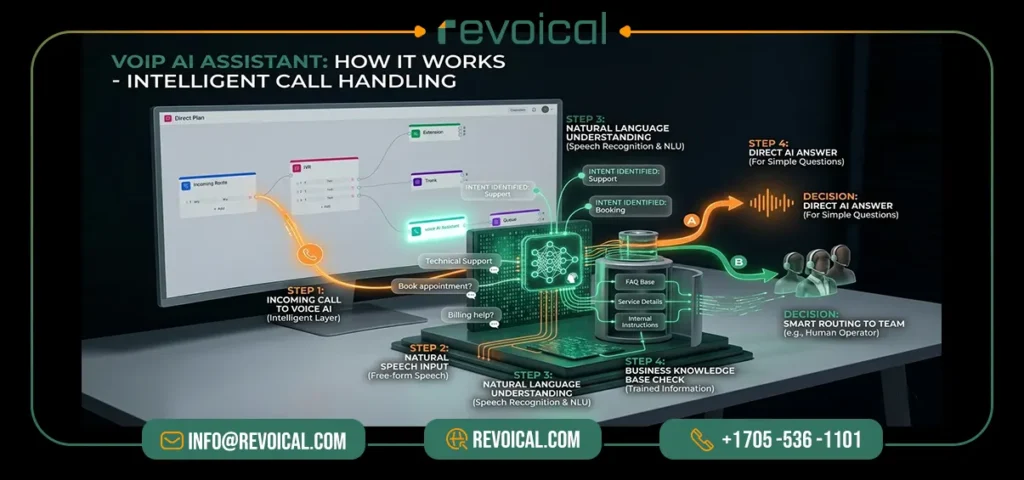
A VoIP AI assistant or AI assistant on call works by adding an intelligent voice layer to the normal business phone system. When a customer calls, the call can first be handled by an AI-powered call handler instead of going directly to a queue, department, or fixed phone menu.
This smart voice component listens to the caller, understands the request, and decides whether to answer directly or transfer the call to the right destination.
The process is usually simple from the caller’s point of view, but several steps happen behind the scenes:
1. The call reaches the intelligent voice layer
When an incoming call enters the VoIP system, it can be directed to the AI phone assistant as the first point of contact. This gives the business a smarter way to manage calls before they reach an operator, department, or call queue.
2. The call reaches the intelligent voice layer
When an incoming call enters the VoIP system, it can be directed to the AI phone assistant as the first point of contact. This gives the business a smarter way to manage calls before they reach an operator, department, or call queue.
3. The system understands the caller’s intent
The virtual voice agent analyzes the caller’s words to understand the main reason for the conversation. In simple terms, it tries to identify what the caller wants and what should happen next. Modern voice AI systems commonly use speech recognition and natural language understanding to interpret free-form speech, identify intent, and generate relevant responses.
4. The voice agent checks business information
After understanding the request, the system uses the information it has been trained on. This may include FAQs, service details, support documents, product information, internal instructions, or department-specific knowledge. This helps the AI voice agent provide answers that are relevant to the business, not generic responses.
5. The call is answered or routed
If the question is simple, the voice system can answer it directly. If the caller needs human support, it can transfer the call to the right route, team, or operator. This helps reduce unnecessary transfers and gives callers a clearer path to the support they need.
In simple terms, a VoIP AI assistant listens, understands, answers, and routes calls based on the caller’s needs. It makes the phone system more intelligent without making the experience more complicated for the customer.
Related Featurs: Advanced Voice & AI Features
Training the AI Assistant With Your Business Knowledge Base
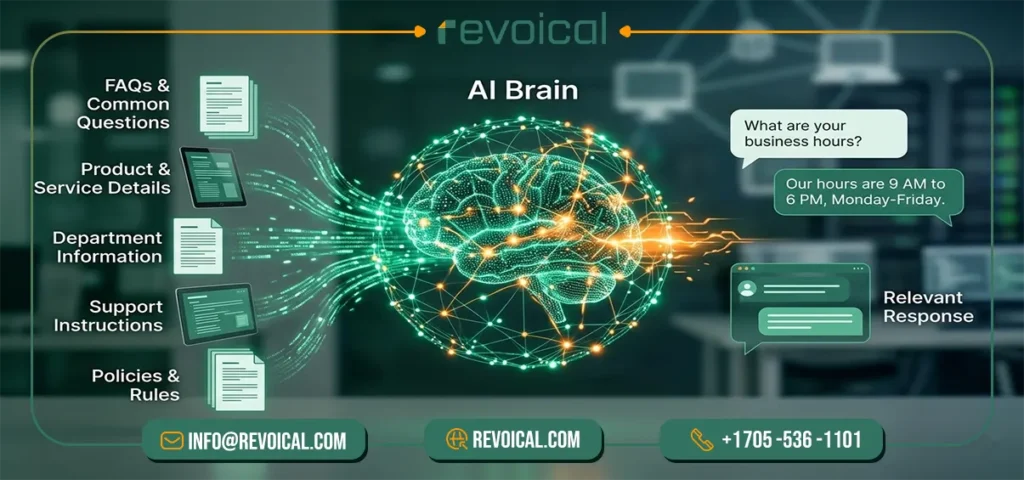
A VoIP AI assistant becomes more useful when it understands your business, not just general questions. That is why training it with a business knowledge base is an important part of the setup. The more accurate and organized your information is, the better the voice system can respond to callers.
In a modern VoIP platform, businesses can provide the AI-powered call handler with the information it needs to support real conversations. This may include:
- FAQs: common questions about services, pricing, support, delivery, or business hours
- Product or service details: clear explanations of what the company offers
- Department information: details about sales, support, billing, technical teams, or other internal routes
- Support instructions: steps the voice agent should follow before transferring a call
- Policies and service rules: information about refunds, appointments, availability, or account support
- Call scenarios: examples of how different types of customer requests should be handled
With this information, the AI voice agent can give answers that are more relevant to the business. For example, it can explain a service, answer a pricing question, collect the caller’s details, or understand which department should receive the call. Instead of giving generic responses, the system uses the company’s own content as its reference point.
This also helps keep the customer experience consistent. Every caller receives information based on the same approved knowledge base, whether they call during business hours or after hours. For businesses, this means fewer repetitive questions for staff and a more reliable first step for incoming calls.
As the business grows, the knowledge base can also be updated. New services, new support rules, updated pricing, or new department instructions can be added so the AI phone assistant continues to reflect the way the company actually works. This makes the AI layer a flexible part of the VoIP system, not a fixed script that becomes outdated over time.
AI Assistant vs Traditional IVR: What Is the Difference?
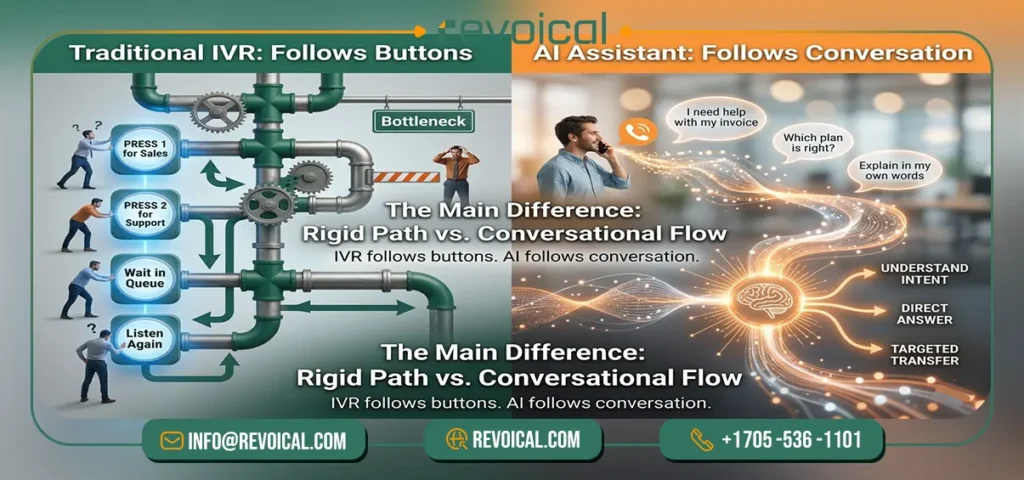
Traditional IVR systems have been used for years to guide callers through phone menus. They usually work with fixed options such as “Press 1 for sales” or “Press 2 for support.” This model can be useful for simple call routing, but it often becomes frustrating when callers do not know which option to choose or when their request does not fit into the available menu.
An AI Assistant in VoIP works differently. Instead of forcing callers to follow a fixed path, it allows them to explain what they need in their own words. The intelligent voice layer can understand the caller’s intent, respond with relevant information, and decide the best next step based on the conversation.
- Traditional IVR follows fixed menus
A traditional IVR is based on predefined rules. The caller listens to a list of options and chooses a number. If the menu is too long or unclear, the caller may need to repeat steps, wait longer, or ask to speak with an operator.
This approach works for basic routing, but it is limited when the caller has a more specific question.
- AI voice agents understand intent
An AI voice agent is designed to understand the reason behind the call. For example, a caller may say, “I need help with my invoice,” or “I want to know which plan is right for my business.” The system can recognize the purpose of the call and respond more naturally.
This makes the experience feel less like navigating a machine and more like starting a real conversation.
- AI can respond, not just route
A traditional IVR usually sends the caller from one menu to another. A VoIP AI assistant can do more than that. It can answer common questions, collect useful information, check the business knowledge base, and then decide whether the call should be completed or transferred.
This helps reduce unnecessary call transfers and gives customers a faster way to reach the right result.
- The main difference
The main difference is simple: IVR follows buttons, while AI follows the conversation.
A traditional IVR depends on fixed choices. An AI phone assistant can understand natural language, use business information, and guide each caller based on their actual need. For modern businesses, this creates a smoother, more flexible, and more helpful call experience.
Related Post: VoIP vs Landline vs Mobile
Smart Call Routing: When Should AI Transfer the Call to a Human?
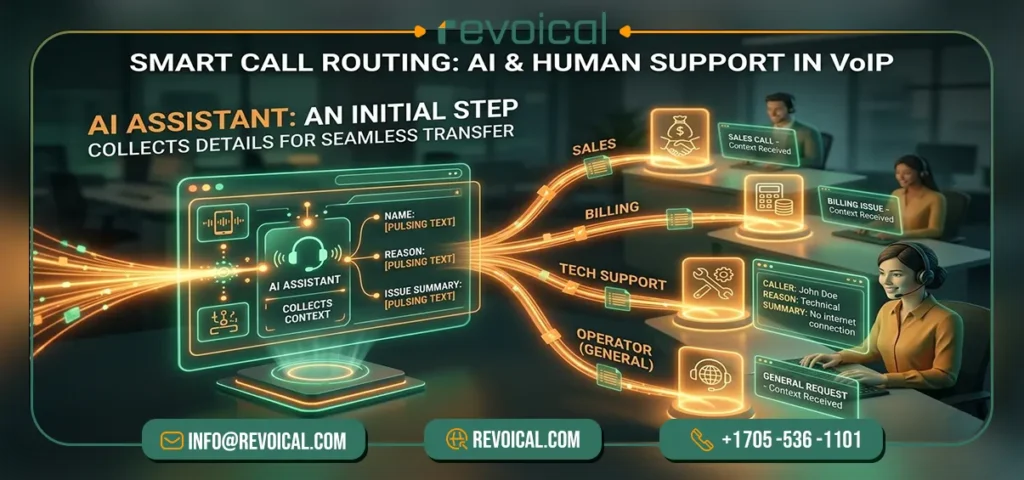
A VoIP AI assistant is not meant to replace every human conversation. Its main role is to answer simple questions, collect useful details, and understand when a caller needs help from a real person.
For example, the AI voice agent can handle common questions about services, pricing, business hours, or basic support. But when the request is complex, sensitive, or related to a specific department, the call should be transferred to the right team.
A smart voice system can route calls based on the caller’s need:
- Sales questions can go to the sales team
- Billing issues can go to the billing department
- Technical problems can go to support
- General requests can go to an operator
The key benefit is context. Before transferring the call, the AI phone assistant can collect the caller’s name, reason for calling, and a short summary of the issue. This helps the human agent continue the conversation without asking the caller to repeat everything.
In simple terms, smart call routing helps businesses combine automation with human support. The AI handles the first step, and the right person takes over when needed.
Related Featur Of Revoical Cloud PBX: Time & Intelligent Routing
Benefits of Using a VoIP AI Assistant
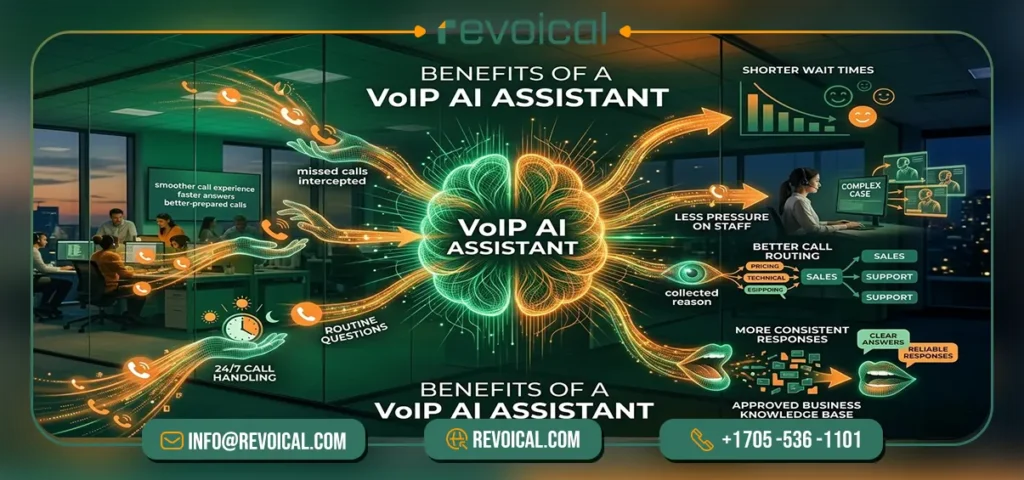
Using a Voice AI Assistant helps businesses manage incoming calls faster and more consistently. Instead of sending every caller to a queue, the system can answer simple questions, collect useful information, and route calls to the right team when needed.
Some of the key benefits include:
- Fewer missed calls: An AI-powered voice layer can answer calls even when teams are busy or unavailable.
- 24/7 call handling: Customers can receive basic support outside normal business hours.
- Shorter wait times: Routine questions can be handled before the caller reaches an operator.
- Less pressure on staff: Human agents can focus on complex or high-value conversations.
- More consistent responses: The AI voice agent uses approved business information, so callers receive clearer and more reliable answers.
- Better call routing: The AI phone assistant can collect the caller’s reason for calling and send the call to the right department.
For businesses, the main benefit is not only automation. It is a smoother call experience where customers get faster answers, and teams receive better-prepared calls.
See More: Advantages of VoIP services
What to Consider Before Adding an AI Assistant to Your Phone System
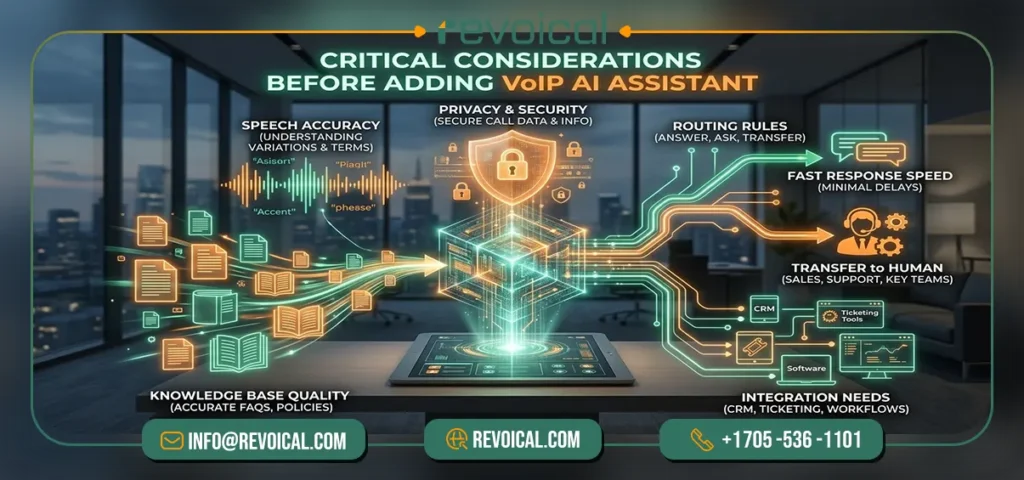
Before adding a VoIP AI assistant to your phone system, it is important to define what the voice system should handle and where human support is still required. A good AI setup depends on clear business information, accurate call routing rules, and a reliable customer experience
Key points to consider include:
- Knowledge base quality: The AI voice agent needs accurate FAQs, service details, policies, and support instructions to give useful answers.
- Speech accuracy: The system should understand different speaking styles, accents, and common business terms.
- Privacy and security: Call data and customer information must be handled carefully, especially when voice conversations include sensitive details.
- Routing rules: The system should know when to answer, when to ask a follow-up question, and when to transfer the call to a human.
- Integration needs: If your team uses CRM, ticketing, or support tools, the AI phone assistant should fit into that workflow.
- Response speed: Callers expect a smooth conversation, so delays between questions and answers should be minimal.
In short, an AI Assistant in VoIP (AI phone answering) works best when it is built around real business needs. The goal is not just to add automation, but to create a smarter and more reliable call experience for both customers and teams
How Revoical Brings Real Voice Conversation With AI to VoIP
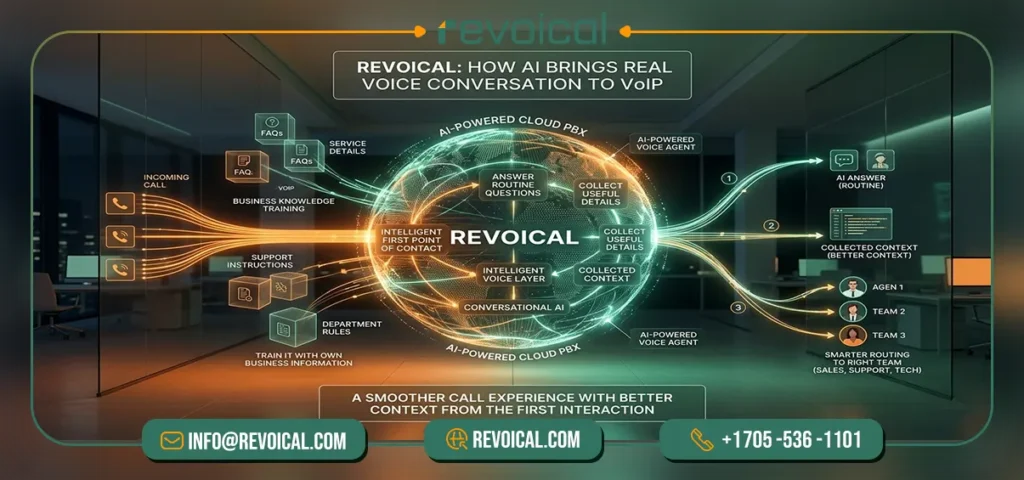
Revoical connects real voice conversations with AI by turning the business phone system into an intelligent first point of contact, not just a tool for receiving calls. As an AI-powered cloud PBX, Revoical brings VoIP, call routing, and conversational AI into one flexible platform for modern business communication.
With Revoical, businesses can add an AI Assistant in VoIP to their call flow and train it with their own business information, such as FAQs, service details, support instructions, and department rules. When incoming calls arrive, the intelligent voice layer can answer routine questions, collect useful details, and route the caller to the right team when human support is needed.
This helps businesses create a smoother call experience from the first interaction. Instead of relying only on fixed menus or manual transfers, Revoical helps companies use an AI voice agent to support faster responses, smarter routing, and more natural customer conversations.
If your business wants to improve call handling with a smarter cloud phone system, Revoical provides the VoIP foundation and AI-powered tools to help every call start with better context.
FAQ
They are closely related, but not always the same. An AI virtual receptionist usually focuses on answering calls, greeting customers, and transferring them to the right person. A VoIP AI assistant can go further by using business knowledge, answering common questions, collecting details, and becoming part of the full call flow.
Automated call handling can manage many routine calls, but it should not replace every human interaction. It works best when it handles simple requests first and transfers complex, sensitive, or high-value conversations to a real team member.
A conversational AI phone system needs clear and accurate business information. This can include FAQs, service details, pricing notes, support instructions, department rules, business hours, and common call scenarios. The better the information, the better the voice system can respond.
AI call routing helps callers reach the right team faster. Instead of asking customers to choose from a long menu, the system can understand the reason for the call and send it to sales, support, billing, or an operator with useful context.
Yes. Voice automation can help small businesses answer more calls, reduce missed opportunities, and provide basic support even when staff are busy. It is especially useful for teams that receive repeated questions or need a more organized way to manage incoming calls.
No comment