
Are VoIP calls secure? In most cases, yes, but the real answer depends on how the system is built, configured, and managed. VoIP technology can offer a high level of voip call security, but it is not automatically secure by default. Like any internet-based communication system, it can face certain voip security risks, including fraud, interception, weak access controls, and poor network protection. That is why many businesses ask not only is VoIP secure, but also is VoIP safe, are VoIP phones secure, and is VoIP safe from hackers.
The good news is that modern VoIP platforms can be very secure when the right protections are in place. Features such as encryption, secure authentication, traffic monitoring, and reliable security protocols all play an important role in improving voip safety. In other words, VoIP security is not based on one single feature. It depends on a combination of technology, provider-level protections, and practical VoIP security best practices used by the business itself.
In this guide, we will explain the most common voip security threats, how VoIP encryption works, which voip security protocols and features matter most, and what businesses can do to reduce voip security concerns in real-world use. If you are evaluating a phone system for your company or simply want to understand whether VoIP is a safe choice, this article will give you a clear and practical overview.
Is VoIP Secure?
Yes, VoIP can be secure when it is deployed and managed correctly. If you are asking is VoIP secure, the most accurate answer is that modern VoIP platforms can provide strong voip call security, but that security depends on several factors working together. A reliable provider, proper encryption, secure network settings, and responsible user practices all play a role. So while many businesses ask is VoIP safe, the better question is whether the system has been built with the right protections from the start.
In practical terms, are VoIP calls secure when compared with other business communication methods? They can be. A well-designed VoIP service can protect call data through encryption, reduce unauthorized access with strong authentication, and improve voip safety through monitoring and access controls.
However, VoIP is not secure by default in every environment. Weak passwords, outdated devices, poor network protection, or misconfigured settings can increase risk even if the platform itself includes strong security features. That is why how secure are VoIP calls often depends less on the technology alone and more on how it is implemented.
For businesses, the answer to can VoIP calls be secure is clearly yes, especially when the provider supports secure infrastructure and the company follows basic security best practices. In that sense, is VoIP safe for business use? Yes, it can be a safe and reliable option when encryption, network security, and user awareness are all taken seriously.
This is also why the topic of voip safe communication should not be reduced to a simple yes-or-no answer. VoIP security is not based on one feature. It is the result of the provider’s protections, the security of the network, and the everyday practices used to keep the system safe.
See More: Revoical Hosted Pbx
Why VoIP Security Matters for Businesses
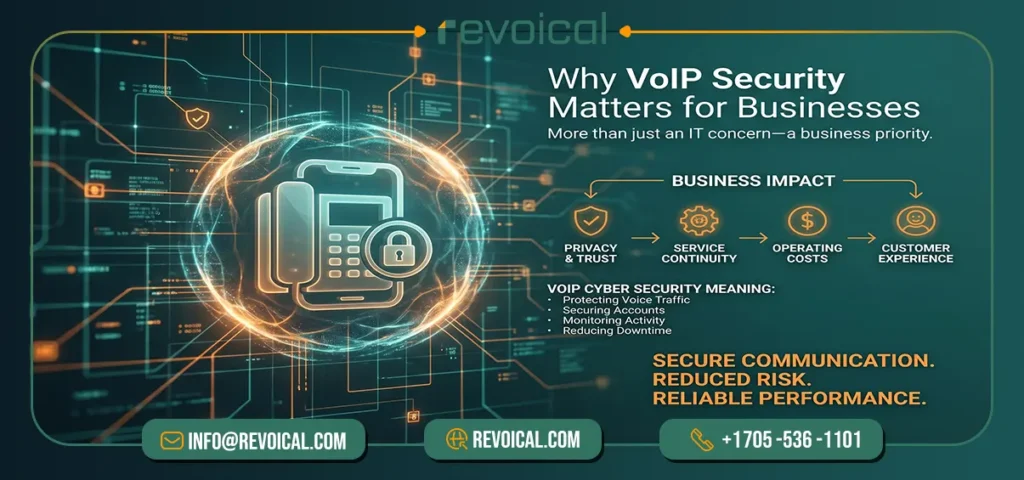
VoIP security is not only a technical issue. For businesses, it directly affects privacy, service continuity, customer trust, and operating costs. If a company does not manage its VoIP environment properly, calls may be exposed, user accounts may be misused, and communication systems may become vulnerable to fraud or disruption. This is why voip cyber security has become an important part of modern business communications, especially for organizations that rely on internet-based calling every day.
In simple terms, voip cyber security meaning refers to the measures used to protect VoIP calls, user accounts, devices, and related data from unauthorized access, attacks, or service abuse. This includes protecting voice traffic, securing login credentials, monitoring suspicious activity, and reducing the chance of downtime.
From this perspective, voip security in cyber security is not a separate topic from broader business security. It is part of the same effort to protect systems, users, and sensitive information across the organization.
The business impact of weak VoIP security can be serious. A security issue may lead to intercepted conversations, service interruptions, account compromise, or unexpected charges caused by toll fraud and other misuse.
For businesses that depend on phone communication for support, sales, or internal coordination, even a short disruption can affect customer experience and daily operations. That is why VoIP security should be treated as a business priority, not just an IT concern. A secure VoIP system helps protect communication, reduce risk, and support more reliable business performance.
See: Security features of Revoical Hosted Pbx
Common VoIP Security Risks and Threats
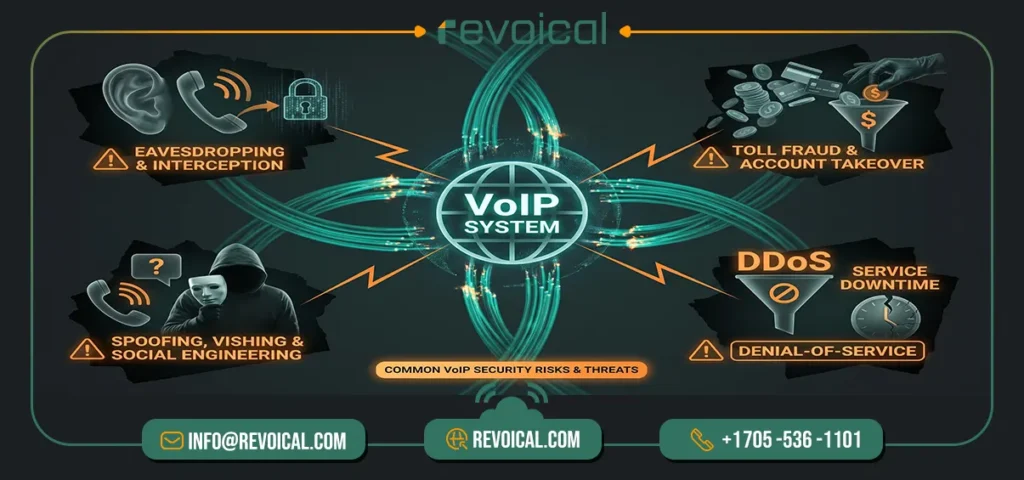
Like any internet-based communication system, VoIP can face a range of security issues if it is not properly protected. Understanding the most important VoIP security risks helps businesses see where problems can begin and why prevention matters. Some VoIP security concerns affect privacy, some disrupt service, and others create direct financial loss. The goal at this stage is not to review every technical detail, but to understand the most common VoIP security threats and how they can affect everyday business communication.
Eavesdropping and Call Interception
One of the most common risks of VoIP calls is eavesdropping. If calls are not properly protected, unauthorized parties may try to listen to conversations or capture voice data while it moves across the network. This is one of the clearest VoIP security vulnerabilities because it can affect private business discussions, customer information, and internal communication. For many companies, this is also one of the main VoIP security concerns, especially when handling sensitive or confidential calls.
Toll Fraud and Account Takeover
Toll fraud happens when attackers gain access to a VoIP account or phone system and use it to place unauthorized calls, often leading to unexpected charges. Account takeover can happen through weak passwords, poor access controls, or exposed credentials. This type of VoIP phone security risk is especially serious because it can quickly create both financial and operational problems. Among the most costly VoIP hacking risks, fraud-related misuse is often one of the first threats businesses want to prevent.
Spoofing, Vishing and Social Engineering
Not all common VoIP threats come from technical weaknesses alone. Some attacks rely on deception. Spoofing can make a call appear to come from a trusted number, while vishing and other social engineering tactics try to manipulate users into sharing information or taking unsafe actions. These VoIP security threats are effective because they target people, not just systems. Even a secure platform can still be exposed if users are tricked into giving access or trusting a fake caller.
Denial-of-Service and Downtime
Some VoIP security risks are designed to disrupt service rather than steal data. In a denial-of-service attack, traffic or requests may overwhelm the system and make calling unstable or unavailable. This can interrupt customer support, sales calls, and internal communication. For businesses that depend on voice services every day, downtime is a major issue, which is why service disruption remains one of the most important VoIP security concerns to address.
Read More: VoIP vs Landline vs Mobile
How VoIP Encryption Works
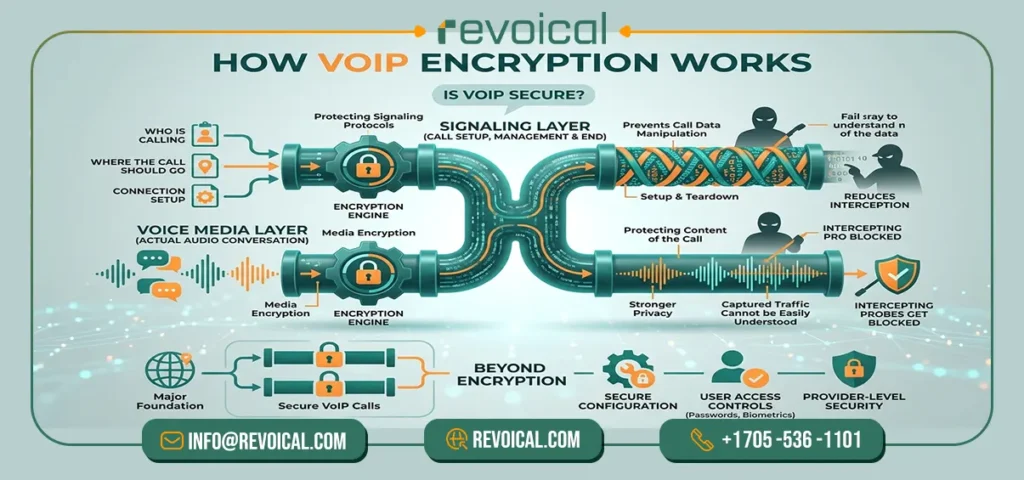
When people ask is VoIP secure, encryption is one of the first things they should look at. In simple terms, VoIP encryption helps protect calls by making important data unreadable to unauthorized users while it moves between devices and networks. This is a core part of VoIP call security because it reduces the chance of interception and helps create more secure VoIP calls. However, encryption in VoIP usually works in more than one layer, and each layer protects a different part of the communication process.
Encryption for Signaling
In a VoIP call, signaling is the part that sets up, manages, and ends the call. This includes information such as who is calling, where the call should go, and how the connection is established. Protecting this layer is important because if signaling is exposed, attackers may be able to view or manipulate call-related data. This is why VoIP security protocols for signaling are an important part of overall protection. When signaling is encrypted properly, the call setup process becomes more secure and harder to interfere with.
Encryption for Voice Media
Voice media is the actual audio of the conversation. This is the part users care about most because it contains the content of the call itself. In encrypted VoIP calling, the voice stream is protected so that even if traffic is captured, the conversation cannot be easily understood.
This is one of the main reasons businesses rely on VoIP encryption to improve privacy and strengthen VoIP call security. Put simply, if signaling protects the connection process, media encryption protects what is actually being said.
Why Encryption Matters in VoIP Calls
Understanding how VoIP encryption works helps explain why it matters so much in business communication. Encryption supports privacy, reduces exposure to interception, and helps make calls safer across public and private networks. At the same time, encryption alone does not answer the full question of is VoIP secure.
It is one of the most important protections, but secure configuration, user access controls, and provider-level security also matter. In other words, encryption is a major foundation for secure VoIP calls, but it works best as part of a broader security approach.
VoIP Security Protocols and Features
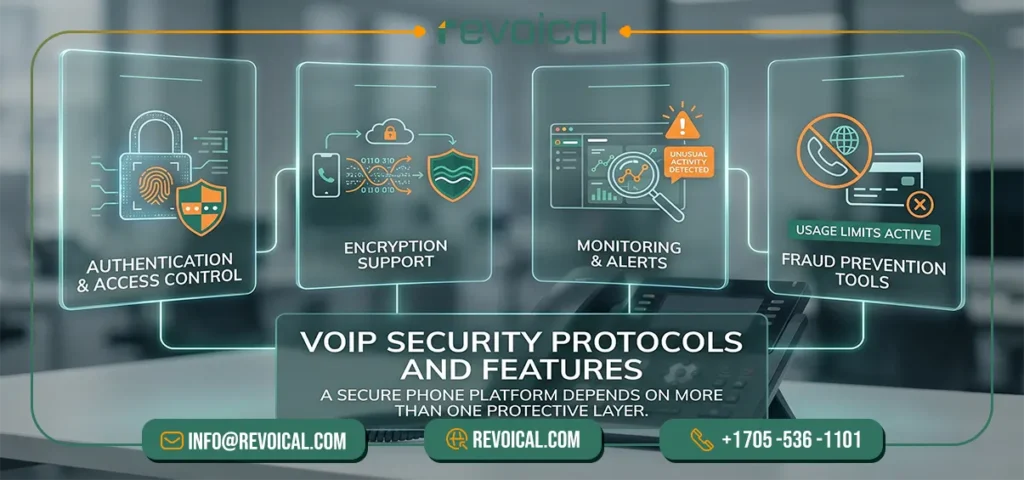
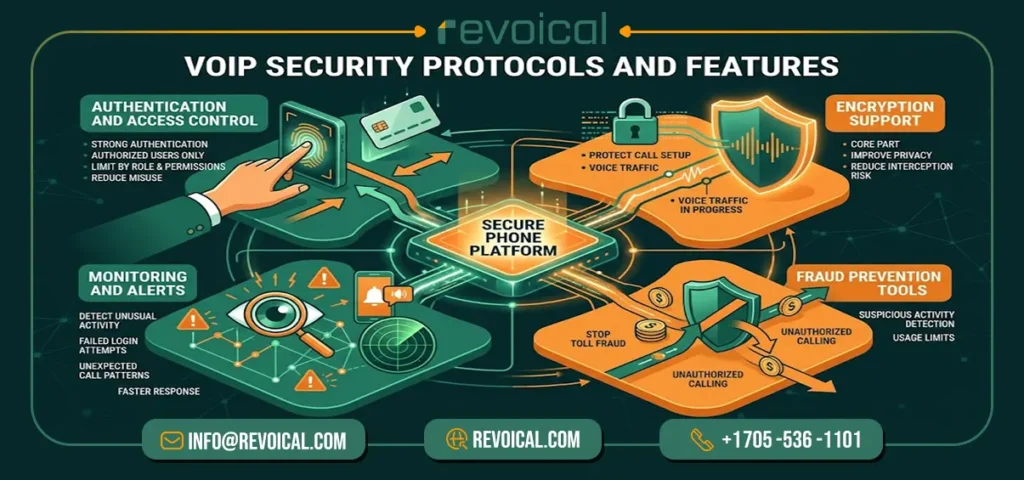
A secure phone platform depends on more than one protective layer. In practice, the strength of a VoIP security system comes from a combination of built-in controls that protect user access, call data, service availability, and account activity. That is why businesses evaluating VoIP security protocols, VoIP security features, and broader VoIP security solutions should focus on the main protections that reduce risk in everyday use.
1. Authentication and Access Control
One of the most important VoIP security features is strong authentication. This helps make sure that only authorized users can access the system, devices, and admin settings. Access control is just as important, because not every user should have the same level of permission. In a well-designed VoIP security system, administrators can limit access by role, reduce unnecessary permissions, and lower the chance of misuse or unauthorized changes.
2. Encryption Support
Encryption is another core part of modern VoIP security protocols. It helps protect call setup information and voice traffic while calls are in progress. For most businesses, this is one of the most important VoIP security solutions because it improves privacy and reduces the risk of interception. A VoIP platform with strong encryption support offers a higher level of protection for both users and business communications.
3. Monitoring and Alerts
Monitoring tools help businesses detect unusual activity before it becomes a larger problem. This can include failed login attempts, unexpected call patterns, unusual international usage, or sudden changes in traffic. These types of VoIP security features are valuable because they improve visibility and allow faster response. In many cases, alerts are a practical part of a stronger VoIP security system, especially for companies that rely heavily on phone communication.
4. Fraud Prevention Tools
Fraud prevention tools are designed to reduce misuse, unauthorized calling, and billing-related abuse. These VoIP security solutions may include usage limits, suspicious activity detection, access restrictions, and other controls that help stop toll fraud or account compromise. For businesses, these protections are not just technical extras. They are part of the essential VoIP security protocols and system features that help keep communication safer and more reliable.
Read More: Telephony Protocols of Hosted Pbx
VoIP Security Best Practices for Businesses
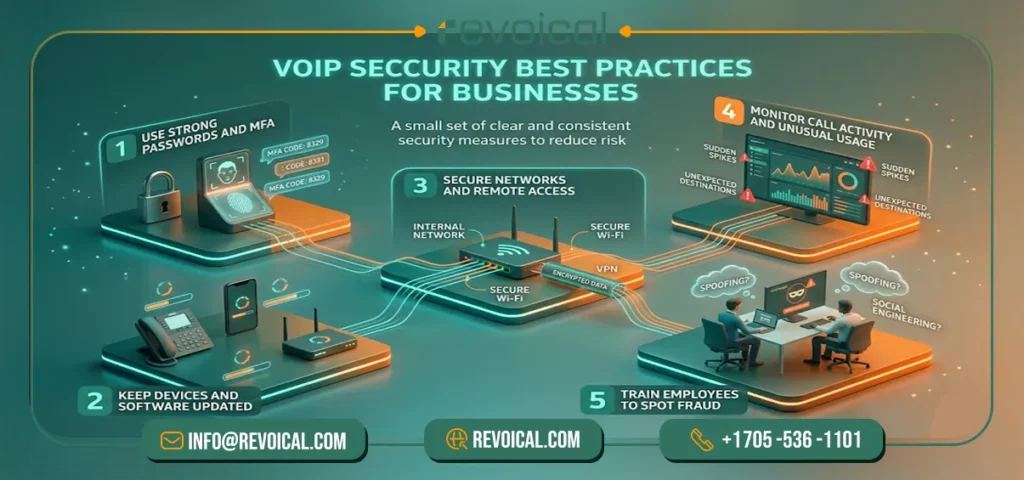
The most effective way to reduce risk is to follow a small set of clear and consistent security measures. In practice, VoIP security best practices are not about making a system complicated. They are about putting the right protections in place and maintaining them over time.
For businesses wondering how to secure a VoIP system, the goal is to focus on a few practical actions that improve day-to-day protection without creating unnecessary complexity. These are some of the most useful practical VoIP security steps for building safer business communications.
Use Strong Passwords and MFA
Strong passwords are one of the simplest but most important VoIP security tips. Weak or reused credentials make it easier for attackers to access accounts, devices, or admin portals. Adding multi-factor authentication provides an extra layer of protection and is one of the best VoIP security solutions for reducing unauthorized access. For many businesses, this is also one of the best ways to protect VoIP calls from account misuse and fraud.
Keep Devices and Software Updated
Regular updates help fix known vulnerabilities and improve the overall security of the system. Phones, softphones, routers, and management portals should all be kept up to date. This is one of the most practical parts of VoIP security best practices, because outdated software can leave even a well-configured system exposed. Keeping systems updated is a basic but essential step for any business asking how to secure a VoIP system.
Secure Networks and Remote Access
VoIP traffic is only as safe as the environment it runs on. Businesses should protect their internal network, secure Wi-Fi access, and control how remote users connect to the system. Limiting unnecessary exposure and using secure connections are important practical VoIP security measures, especially for distributed teams. Among the best ways to protect VoIP calls, securing the network is one of the most important because it affects every call and every user.
Monitor Call Activity and Unusual Usage
Monitoring helps businesses spot problems early. Unusual call patterns, unexpected destinations, failed login attempts, or sudden spikes in usage can all be warning signs. This is why monitoring is one of the most useful VoIP security solutions for businesses that want better visibility and faster response. As part of broader VoIP security best practices, regular review of call activity helps reduce fraud risk and supports more reliable service.
Train Employees to Spot Fraud
Not every security issue starts with a technical weakness. Many attacks rely on human error, confusion, or trust. Employees should know how to recognize suspicious calls, unusual requests, and signs of spoofing or fraud. This is one of the most overlooked but most effective VoIP security tips, because user awareness plays a major role in preventing avoidable mistakes. For companies looking for practical VoIP security steps, basic employee training is a smart and necessary part of the process.
How to Assess Whether Your VoIP System Is Secure
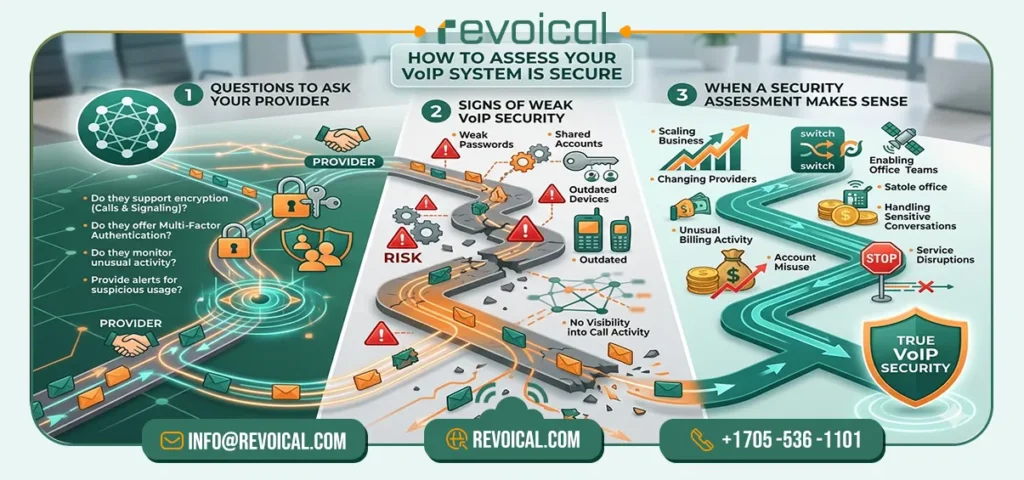
You do not need a highly technical audit to start evaluating your phone system. In many cases, a simple review of your provider, settings, access controls, and daily usage can show whether your setup is reasonably protected or whether it has clear weaknesses. If you are wondering how to assess VoIP security or how to know if VoIP is secure, the best starting point is to look at a few practical indicators rather than only technical details. A basic VoIP security checklist can often reveal whether your system is well protected or whether a deeper VoIP security assessment may be needed.
Questions to Ask Your Provider
One of the easiest ways to begin is to ask your provider direct questions about security. For example, do they support encryption for calls and signaling, offer multi-factor authentication, monitor unusual activity, and provide alerts for suspicious usage?
It is also worth asking how user access is controlled, how updates are handled, and what protections are in place against toll fraud or unauthorized access. These questions help answer concerns such as are VoIP phones secure and whether the service includes the protections expected from a modern business phone platform.
Signs of Weak VoIP Security
There are also some clear warning signs that a VoIP setup may not be well protected. Weak passwords, shared accounts, missing authentication controls, outdated devices, open remote access, and no visibility into call activity can all point to poor security.
If a business cannot clearly see who has access, how calls are protected, or whether suspicious usage is being monitored, that usually means the system needs closer review. In that situation, the question is not only are VoIP phones secure, but also is VoIP safe from hackers under the current setup. In many cases, the answer depends on whether these gaps are addressed.
When a Security Assessment Makes Sense
A formal VoIP security assessment becomes more important when a business is scaling, changing providers, enabling remote teams, or handling sensitive customer conversations. It is also useful after unusual billing activity, account misuse, repeated login problems, or service disruptions.
The goal is not to make the process overly technical, but to confirm that the platform, network, devices, and user controls are aligned with basic security expectations. For many businesses, this is the most practical way to move from uncertainty to a clearer understanding of whether their VoIP environment is truly secure.
Final Verdict: Is VoIP Safe for Business Use?
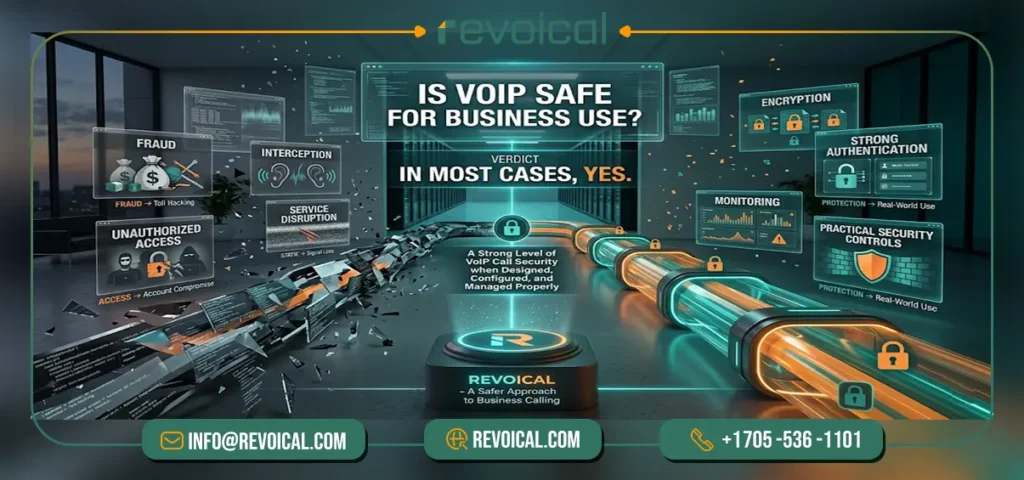
So, is VoIP safe for business use? In most cases, yes. VoIP is not inherently insecure, and modern business phone platforms can provide a strong level of VoIP call security when they are designed, configured, and managed properly. This means the answer to questions such as are VoIP phones secure is generally yes, but only when the service includes the right protections and follows sound security practices.
At the same time, VoIP is not automatically secure simply because it is cloud-based or internet-enabled. Businesses still need encryption, strong authentication, monitoring, and practical security controls to reduce risk. Without these protections, issues such as fraud, interception, unauthorized access, and service disruption become more likely. That is why the question is VoIP safe from hackers depends less on the technology itself and more on how well the system is protected in real-world use.
In short, VoIP can be a secure and reliable choice for business communication when the right security measures are in place. If your business is evaluating a hosted phone system and wants a platform built with security, reliability, and modern VoIP protection in mind, Revoical can help you explore a safer approach to business calling.
FAQ
VoIP cyber security meaning refers to the policies, tools, and protections used to keep internet-based phone systems safe from misuse, fraud, interception, and service disruption. In simple terms, it covers the security of calls, accounts, devices, and the network environment around them.
A VoIP security assessment is a review of how secure your VoIP environment is. It usually looks at account protection, access settings, encryption, device security, call activity, and possible weak points. For businesses, this is a useful way to identify gaps before they turn into larger problems.
The biggest VoIP phone security risk often comes from weak passwords, poor access control, and lack of visibility into suspicious activity. In many small businesses, simple security gaps can create opportunities for account misuse, fraud, or unauthorized access.
The best practical VoIP security approach is to start with a few high-impact actions. Use strong passwords, enable multi-factor authentication, keep devices updated, limit unnecessary access, and monitor call activity regularly. These basic steps form a strong foundation before moving to more advanced protections.
Some of the most important VoIP security features to look for include encryption support, strong authentication, role-based access control, fraud detection, monitoring tools, and alerting capabilities. These are also among the most valuable VoIP security solutions for businesses that want better protection without adding unnecessary complexity.
No comment